|
Sl. No. |
Title |
Treatments |
|
|
Crop Production |
|||
|
1 |
Assessment of natural farming module paddy for maintaining soil health and sustainable yields |
T1 - APCNF POP Seed treatment with 5 % Beejamrutham, 100 kg FYM + 400 kg Ghanajeevamrutham per acre, Jeevamrutham @ 400 litre/acre as spray covering both soil and crop or soil application as drenching from 15 DAS till 15 days before harvesting, whichever is feasible at 15 days interval, manual weeding, Azolla 5 kg, Use of Neemasthram (100 l/ac), Agniasthram (6 l/ac), Bramhastram for pest control and sour butter milk (6 lit make up to 150 Lit) & Plant growth promoters for disease control T2 - ANGRAU Nutrient package: Green manure with Dhiancha @ 15 kg per acre and in situ incorporation at 50% flowering, FYM@ 4 t/acre, Azospirillum, PSB and KRB @ 2 kg/acre or 500ml/acre each along with 100 kg FYM at the time of planting, neem cake@ 200kg/acre or vermicompost @ 500 kg /acre at tillering and PI stage Pest management practices: Application of Pseudomonos fluorescence spray @10ml/lit, Azadirectin 3000 ppm at nursery, 10 and 25 DAT @ 5 ml/L, Trichogramma japonicum (Trichocards) @ 40,000/acre/release, erection of bird perches @20 per acre, installation of pheromone traps @8 per acre, formation of alleyways, alternate wetting and drying and 5 % NSKE (neem seed kernel extract) T3 - Farmers practice – Chemical farming(150:120:0-30 Kg NPK/ha) |
|
|
2 |
Assessment of Integrated use of VAM and ZnSO4 on ‘P’ Nutrition and Performance of redgram in high phosphorus soils |
T1:- 20 N + 25 kg P2O5/ha + 20 kg ZnSO4/ha + VAM 12.5 kg/ha T2 – RDF (20 N + 50 P205) FP- Farmers practice (DAP or Use of complex fertilizers). |
|
|
3 |
Assessment on nitrogen management through leaf colour chart (LCC) in Maize |
T1 - Nitrogen (N) management through Leaf colour chart (LCC) T2 - Soil test based Nitrogen management T3- Farmers practice (250-60-00 NPK/ha) |
|
|
4 |
Assessment of handpush seed drill for line sowing in Maize |
T1: Handpush seed drill T2: Mechanical Planting T3: Manual sowing |
|
|
Plant Protection |
|||
|
1 |
Assessment of efficacy of bio-intensive management of BPH in organic rice |
T1 - formation of alleyways, alternate wetting and drying field, spraying of 5%NSKE (Neem seed kernel extract), Tutu kadakashayam and Metarhizium rileyi 2g/lit T2 –Spraying of insecticides acephate 1.5g/lit and pymetrozin 0.6g/lit. T3 –Spraying of pexalon @ 0.48ml/lit |
|
|
2 |
Assessment of methyl eugenol traps for the management of guava and mango fruit fly. |
T1 - Remove and destruction of infected and fallen fruits. ⮚ Regular ploughing of the soil in the basin to destroy the pupal stage. ⮚ Ethyl alcohol 60ml + methyl eugenol 40ml+malathion 20 ml ⮚ Wrapping of fruits. T2 – Methyl eugenol 2ml + malathion 2ml+1 litre water + soaked fly wood pieces.If incidence is more arrangement of 100 g jaggery + 5ml malathion bait in different places of garden T3 –spraying of malathion |
|
|
3 |
Assessment of integrated disease management against viral diseases in greengram |
T1 - Sowing of resistant variety LGG-607
T2 –Seed treatment with Thiamethoxam 30%FS @ 10ml/kg
Thiamethoxam 25 % WG @ 0.2 g/lit Imidacloprid 17.80 % SL @ 0.2 ml/lit Buprofezin 25 % SC @ 2 ml/lit. T3 –indiscriminate use of insecticides: Solomon (Beta-cyfluthrin 8.49+Imidacloprid 19.81 OD) 1ml/lit |
|
|
4 |
Assessment of integrated management of pod borer complex and SMD of pigeonpea. |
T1 - Seed treatment with imidacloprid @ 5g/kg seed and rhizobium @ 10g/kg seed. ⮚ Application of dicofol 5ml/litre at 35-40 DAS, followed by application of propergite @ 2ml/litre at 60-65 DAS. ⮚ Application of azadirachtin 1500 ppm @ 5ml/litre at flower bud initiation stage. ⮚ Application of Bt.kurstaki at 50% flowering, followed by chlorantraniliprole @ 0.3ml/lit, cypermethrin @ 0.4 ml/lit. T2 –Roughing out infected plants upto 40 days after sowing; spraying with fenazaquin 10% EC @ 200 ml/are after appearance of the disease and if necessary repeat after 15 days against mites. ⮚ Spraying of emamectin benzoate 5% SG 0.4 g/lt, chlorantraniliprole 18.5 SC @ 0.3 ml per litre. T3 – Spraying of cyfluthrin + imidacloprid 300 OD @ 1ml/lit (Slomon), novaluron+ emamectin benzoate 1.5ml/lit (Barazide). |
|
|
Horticulture |
|||
|
1 |
Assessment of YVMV resistant okra variety Kashi Chaman |
T1-Kashi Chaman T2 -Punjab Suhawani T3-Farmer’s Practice (Super Green) |
|
|
2 |
Assessment of marigold hybrids Arka Abhi and Arka Bhanu |
T1- Arka Abhi T2- Arka Bhanu T3-Farmer’s practice –Indus 27 |
|
|
3 |
Assessment of Chilli hybrid Arka Yashasvi against local hybrids |
T1:ArkaYashasvi T2: MahycoYashaswini T3:Farmers practice (Teja) |
|
|
4 |
Assessment of brinjal varieties Arka Keshav and Arka Nidhi |
T1: Arka Keshav T3:Farmers practice (Kanakadurga) |
|
|
Veterinary Science |
|||
|
1 |
Assessment of probiotic yeast supplement on milk production in milch buffaloes |
T1: Concentrate feed + Probiotic yeast 15grams/day + 2% sodium bi carbonate T2: Concentrate feed + Probiotic yeast 5g/day FP: Concentrate feeding |
|
|
2 |
Assessment of Moringa leaf supplement on body weight in weaned lambs |
T1:Concentrate feed incorporated with 10% moringa leaf meal T2: Concentrate feed incorporated with 5% moringa leaf meal FP: Concentrate feed |
|
|
3 |
Assessment of improved fodder sorghum CoFS 33and leguminous fodder perennial for round the year fodder production |
T1: CoFS 33 + hedge lucerne T2: CoFS 31 + hedge lucerne Farmers practice : Sorghum Sudan grass |
|
|
4 |
Assessment of different poultry breed suitable to backyard |
T1: Ghagus T2: Rajasri Farmers practice : desi birds |
|
|
Home Science |
|||
|
1 |
Assessment of dehydration of vegetables and fruits through different drying techniques |
T1 : Solar cabinet dryer T2: Electrical drying T3: Open sun drying (Farmers Practice) |
|
|
2 |
Assessment of millet based breakfast mixes |
T1- Jowar ravva mix (Jowar ravva mix 100%) T2-Jowar+Wheat ravva ready mix (Jowar ravva (50%)+ Wheat ravva (50%) FP- Wheat ravva mix (Wheat ravva mix 100%) |
|
|
3 |
Assessment of antioxidant rich millet based nutribars |
T1 = Antioxidant rich millet bars (Source: ANGRAU, 2023) T2 = Millet Nutribars (Source: IIMR) T3 = Locally available nutribars /energy bars) |
|
|
4 |
Assessment of whey-Fruit juice probiotic beverages |
T1 = Whey – Fruit juice (locally available) based beverage T2 = Whey – Apple juice beverage (source: ANGRAU, 2022) T3 = Local Milk based beverages |
|
|
Extension Studies |
|||
|
1 |
Knowledge and adoption level of the farmers towards scientific rearing practices of livestock in NTR District |
||
|
2 |
Critical analysis of natural farming practices followed in NTR District |
||
|
3 |
A study on Impact of technology interventions of KVK in NTR district of Andhra Pradesh |
||
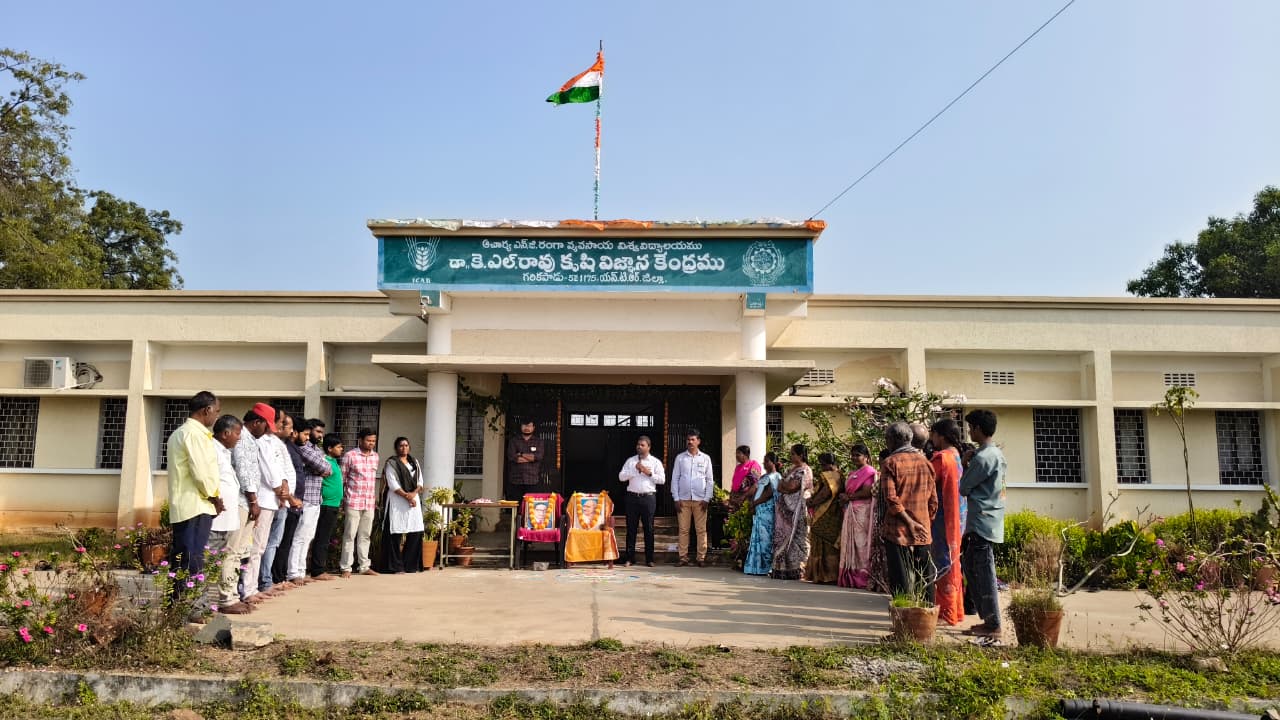
Indian Council Of Agricultural Research
ACHARYA N.G.RANGA AGRICULTURAL UNIVERSITY
KRISHI VIGYAN KENDRA
GARIKAPADU-521 175
Krishna District , Andhra Pradesh
.jpg)
.PNG)
.jpg)
(c) 2013 Your Copyright Info
E - Mail : info@kvkgarikapadu-angrau.org